Trust is built like you train an intern
People mentally simulate oversight loops—what they check first, what proof counts—and automation has to earn passes through those same gates.
Superlabs is a pre-seed startup with a bold idea: non-technical people should be able to automate their own workflows, without IT, without a developer, and without a three-month implementation. We were brought in to figure out what that actually looks like.
Company
Superlabs Inc.
Product
Okto
My role
Product Designer
Team
4 (2 designers, 1 PM, 1 researcher)
Status
Ongoing · Spring 2026
There was no mature product to iterate on—only hypotheses, investor decks, and the founder's proof that bespoke automations could be stitched together manually if someone technical babysat the toolchain long enough.
Our challenge was to translate that founder grit into something repeatable: an experience where operations-minded people could externalize tacit process knowledge without feeling like they had joined an engineering team by accident.
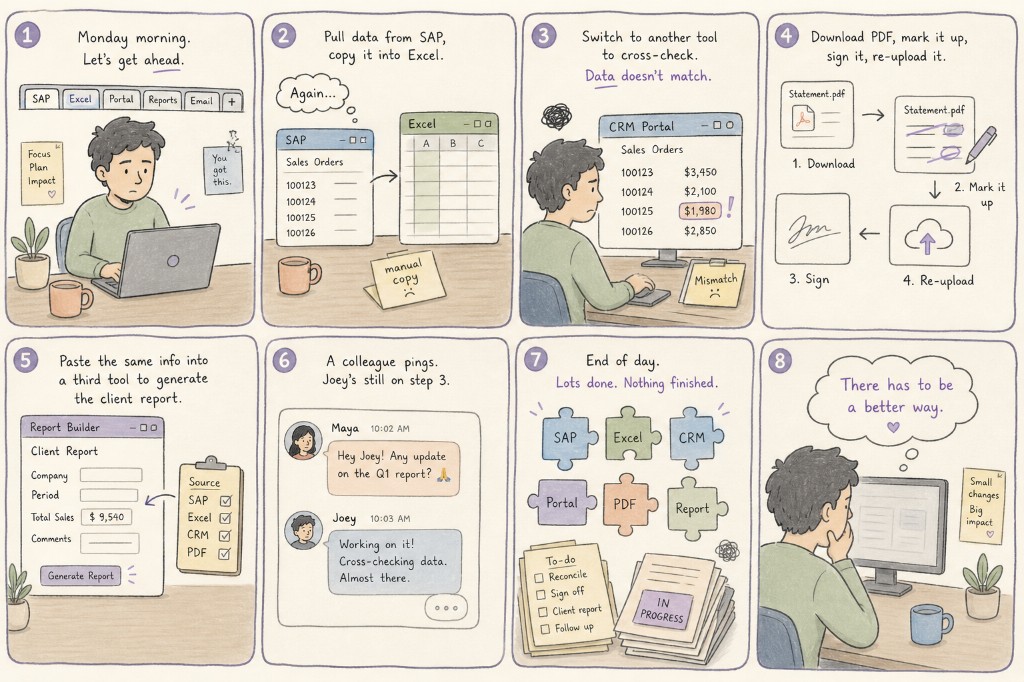
The scope we landed on
After months of research and iteration, we focused on one moment: the first time a user sits down to capture their workflow and hand it to an AI. Get this right, and the rest becomes possible.
We paired foundational interviews with diary prompts about “what broke last week” so people weren't performing expertise—they were narrating friction. The same phrases surfaced again and again: visibility, blame, and the quiet shame of not knowing which tool actually held the truth.
Synthesis wasn't a tidy persona exercise; it was an argument with ourselves about what automation replaces (clicks) versus what it must preserve (accountability and narrative).
0
sessions across roles and industries0%
of the workday spent on manual tasks (self-reported bands)4
core themes from affinity clusteringPeople mentally simulate oversight loops—what they check first, what proof counts—and automation has to earn passes through those same gates.
Excitement evaporates when outputs land in someone else’s inbox with no shared story about how they were produced.
The scary part isn’t “AI”; it’s not being able to point to the moment the system misunderstood you.
Office managers already translate between tools; we’re designing for people who broker glue work between SaaS islands.
“I need to see with my own eyes that it's doing it the right way before I start trusting it.”
We mapped vendors across two axes: how technical the buyer expects to be, and how much of the workflow lives inside a single vendor versus orchestration across tools. The crowded quadrant was “enterprise IT installs this for you”—thin air for the admin lead wiring fourteen SaaS apps.
That gap clarified positioning: Okto isn't permissioned automation inside one suite—it's legible capture across the messy reality of operational glue work.
Competitive landscape logos in three rows of three: Gumloop, Flowise, Dify, Power Automate, Palantir Foundry, Vercept, ServiceNow, Tropic, and Zylo.
 Gumloop
 Flowise
 Dify
Dify Power Automate
 Palantir Foundry
 Vercept
 ServiceNow
 Tropic
 Zylo
ZyloTechnical complexity remains a barrier. Competitors still require dedicated technical teams. Intuitive, conversational approaches consistently stand out as the differentiator.
Users want to prove value on their own terms. Free trials, self-serve dashboards, and small implementations let users experience results before committing.
ROI needs to be visible and specific. The most effective competitors quantify savings in dollar amounts and surface metrics relevant to each user's role.
Vercept
Vercept sat closest to “ambient monitoring” narratives—we pushed harder on consentful capture and reversible teaching moments rather than silent observation.
Five takeaways anchored downstream decisions: sell outcomes not connectors; pair capture with confirmation UI; avoid surveillance framing; design for partial automation; and assume every workflow has a human escalation path that must remain dignified.
Journey explorations stayed deliberately messy—whiteboards with parallel flows for billing, onboarding vendors, and exec scheduling—until patterns condensed into three interacting modes instead of three disconnected features.
Ambient capture with explicit start/stop cues so “being watched” transforms into “being taught.”
Lightweight clarifying questions that stitch gaps without turning setup into an interrogation.
A readable dialogue layer where corrections feel like coaching—not debugging terminal output.
Recording mode carried the most baggage culturally—associations with surveillance tooling ran hot—so we prototyped consent rhythms, visible indicators, and granular deletion paths before we chased clever inference.
What consolidated was less a linear funnel than a spiral: capture enough fidelity to replay, pause for human checkpoints at ambiguous forks, and let conversation compress weeks of tacit knowledge into something shareable.
Each assumption—what counts as a step, whether narration is natural, how collaborators enter frame—had downstream implications for trust and legal comfort. We surfaced disagreements early so engineering didn't optimize the wrong latency bottleneck.
How much is enough?
Define minimum viable fidelity without pushing users into infinite capture anxiety—or brittle, overfitted automations.
Will users actually narrate?
Test prompts, pacing, and recovery when someone forgets mid-flow; narration can't be the only channel for intent.
Real-time feedback: helpful or surveillance?
Balance reassurance cues against the feeling of being scored while doing normal work.
What about collaborative workflows?
Attribute edits without turning coworkers into suspects; shared ownership needs shared safety.
The tension we kept returning to
Visibility heals trust when it's paired with control—otherwise it becomes proof-of-work theater that punishes the people we're trying to empower.
Open questions became guardrails: we documented them publicly inside the team so scope debates referenced risks instead of personalities—especially where product metaphors touched enterprise procurement realities we hadn't stress-tested yet.
Parts vs. wholes
Should automation chunks mirror tickets, emails, or human mental models of “the job”?
Controls without overwhelm
Progressive disclosure versus expert surfaces—who earns density, and when?
What happens offline?
Capture degrades gracefully when VPNs fail mid-task—the workflow can't strand Maria.
Resilience over time
Drift detection when apps update underneath recorded flows—how loudly should Okto complain?
The escalation chain
When automation misfires, who sees it first—and what language prevents blame cascades?
We recruited participants with operational breadth—not just software fluency—and ran moderated sessions that emphasized think-aloud during capture and retrospective trust calibration after.
Prototypes diverged on how explicitly Okto announced itself in the OS chrome versus staying whisper-quiet until summoned; reactions split cleanly across risk posture and role power dynamics.
Favored by participants who wanted automation to feel like a quiet copilot—until something broke and they hunted for where Okto was “looking.”
Tension · Legibility vs. calm
Preferred when participants wanted theatrical clarity—clear modes, obvious boundaries—at the cost of feeling “always on stage” during sensitive screens.
Tension · Performance anxiety
Results weren't a winner-take-all verdict—they were a calibration curve. Teams with stronger IT partnerships tolerated ambient patterns; smaller shops skewed toward explicit guardrails that doubled as training wheels.
We logged failures as richly as successes: hesitation clicks, repeated pauses at consent screens, and language participants invented to describe “where the agent is” became interaction copy seeds.
The through-line was consent ergonomics: participants forgave imperfection when they felt able to steer, interrupt, and roll back—less so when intelligence felt theatrical or coy.
“Where is Pearl's eye looking right now?”
Presence isn't ornament—it's the semantic bridge between “something smart is happening” and “I can intervene.” We treated indicators as a system: consistent posture in the menu bar, consistent semantics on-screen, and predictable escalation into explicit controls.
The goal was legibility without spectacle: calm defaults that intensify in informational density only when risk or ambiguity spikes.
A quiet heartbeat state when idle; shifts weight subtly during capture without mimicking surveillance recording LEDs.
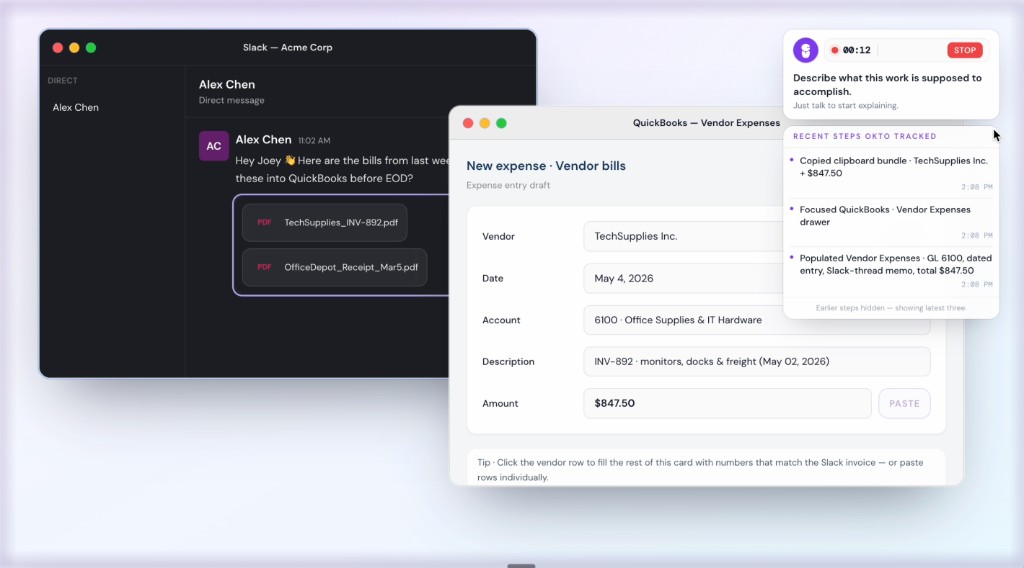
Transient emphasis tied to comprehension—not decorative gradients—so users map AI attention to concrete UI regions.
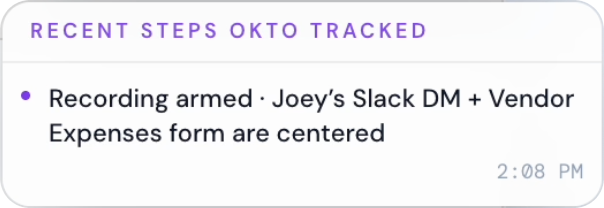
Short, reversible summaries during capture that invite correction (“Did you mean this invoice cycle?”).
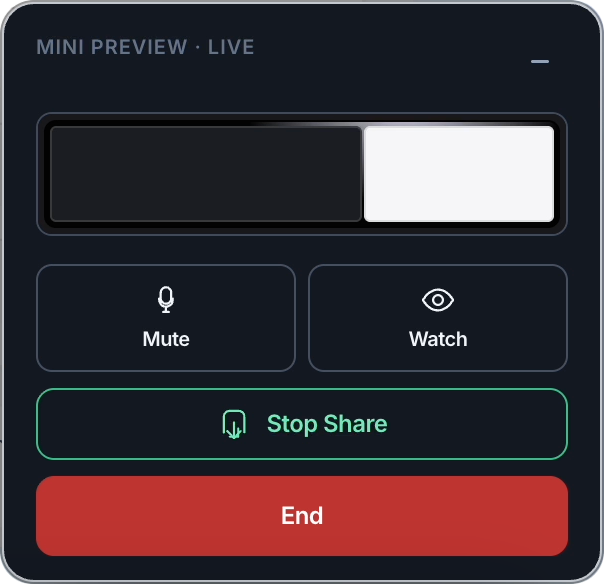
Pause, exclude window, and redaction aren’t buried settings—they’re part of how Okto proves manners.
Where we landed treats automation less like a black box and more like a teammate on a short leash: visible presence, interruptible actions, and language that mirrors how people already explain their jobs across tools.